
Ghana targets 400,000 tonnes of tomatoes, 600,000 jobs under new self-sufficiency drive
Ghana has launched an ambitious drive to produce 400,000 tonnes of tomatoes annually from more than 40,000 acres of land, with the programme projected to create more than 600,000 direct and indirect jobs when fully implemented.
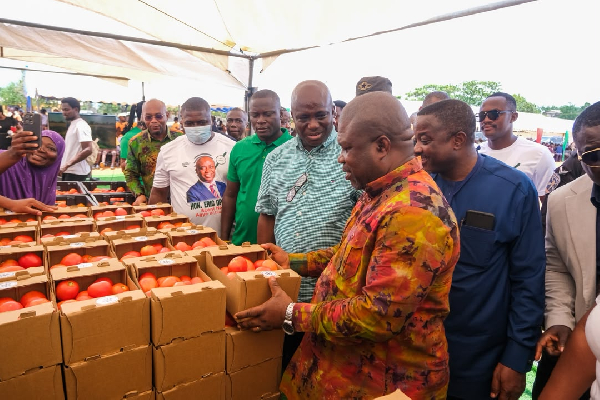
Ghana has launched an ambitious drive to produce 400,000 tonnes of tomatoes annually from more than 40,000 acres of land, with the programme projected to create more than 600,000 direct and indirect jobs when fully implemented.
The Ghana Tomato Self-Sufficiency Initiative (GHATSI), launched at Anloga on Tuesday, is designed to end the cycle of seasonal tomato shortages and surpluses by coordinating production, financing, irrigation, processing and markets throughout the year.
The first phase, covering the 2026/27 production season, targets 100,000 tonnes from more than 10,000 acres, equivalent to about 4,000 hectares, across 35 districts, 10 regions and more than 100 communities.
Food and Agriculture Minister Eric Opoku said the first phase could support more than 150,000 jobs, including approximately 50,000 year-round positions.
At full rollout, employment projections rise to more than 600,000 opportunities, including about 200,000 year-round jobs.
The jobs will span the entire value chain—from nurseries, land preparation, irrigation and farm labour to aggregation, packaging, transport, warehousing, processing, finance, insurance, distribution and retail.
“This is why tomato self-sufficiency is also a youth-employment opportunity,” Mr Opoku said.
The initiative comes against an estimated 300,000-tonne domestic tomato supply deficit during the December-to-July off-season, according to the Minister.
Ghana’s challenge, he said, is not simply inadequate production but poor coordination between production, markets and processing.
GHATSI will therefore stagger planting across the northern, middle and southern production belts to generate successive harvests throughout the year.
The long-term target is to move from the initial 10,000-plus acres to more than 40,000 acres, producing approximately 400,000 tonnes annually.
Up to 200,000 tonnes could eventually be processed into tomato puree and other value-added products, subject to expanded processing capacity and market demand.
FarmMate Ltd, the private-sector implementation partner, says it already has approximately 4,000 acres of organised tomato production underway or entering production.
Founder and CEO Sena Amevor said the company’s out-grower programme currently covers more than 80 tomato-growing communities in 40 districts across 12 regions, with expansion planned to more than 130 communities.
About 200 acres planted in Anloga in May and June are already being harvested, while additional acreage has been established in Ada East, Ningo-Prampram, Shai-Osudoku, Asunafo South, Offinso North, Bawku West, Talensi and Kassena Nankana.
Amevor said the company’s five-year experience had demonstrated that increasing production alone would not solve Ghana’s tomato problem.
“The farmer operates within a much larger system,” he said, pointing to the need to connect farmers to finance, technical support, insurance, markets, aggregation, processing and logistics.
FarmMate is also adding processing capacity to the value chain.
Its tomato processing facility at Legon, Accra, is scheduled to begin operations this month, with an initial capacity of 1.5 to five tonnes per hour.
Across three shifts, the facility could process up to 120 tonnes of fresh tomatoes in 24 hours, with production of tomato puree under the company’s CountryFresh brand.
FarmMate also plans strategically located semi-processing facilities in major production zones, while Government is working towards the rehabilitation of the Pwalugu Tomato Factory.
Amevor said processing would provide an alternative outlet when fresh-market demand could not absorb the crop.
GHATSI’s farmer package is estimated at about GH¢20,000 per acre, covering inputs, land preparation, soil testing, technical support, insurance and other production requirements.
Participating farmers are expected to receive financing through Pan-African Savings and Loans, with repayment linked to structured off-take arrangements.
Source: GhanaWeb (https://www.ghanaweb.com/GhanaHomePage/business/Ghana-targets-400-000-tonnes-of-tomatoes-600-000-jobs-under-new-self-sufficiency-drive-2052590)
— Advertisement —
Ad Slot 728×90
Comments (0)
Loading comments...
Related Stories
Fuel prices may stay high despite easing global tensions – COPEC
Iqra News Desk2026-09-17

GRA Customs revenue surges to $450 million a month after AI rollout
Iqra News Desk2026-09-17

Cedi loses ground as dollar demand intensifies
Iqra News Desk2026-09-17